
Sources for Gahanna Previous Residents at One Address
The path for Gahanna previous residents changes with the era. Current parcel data and recorded documents are strongest for the ownership trail. Telephone books, city-directory material, census schedules, and obituaries add dated household evidence. Municipal address, plat, and annexation files are a separate route when the same place has changed labels or no longer matches the present address.
| Source | Years or period documented | Where held | What it can show |
|---|---|---|---|
| Franklin County Recorder deed index | Modern recorded deed index begins January 2, 1914 | Cloud Search, Recorder counter | Recorded parties, document dates, parcel and legal-description clues. |
| Legacy deed indexes | 1804 to 1913 | Legacy CountyFusion route or Recorder office | Historic grantor or grantee trail using indexed page, volume, and page. |
| Franklin County telephone directories | 1928, 1932, 1936, and 1944 Gahanna items | CML City Directory Collection | Dated subscriber listings, not a complete population list. |
| Federal census | Released censuses through 1950 | National Archives and library research routes | Household evidence at the enumeration date. |
| Gahanna certified-address and plat files | Permanent retention for the named city record series | City records coordinator or NextRequest | Address assignment, grid, plat, as-built, or annexation context. |
Begin with the current parcel when a present address is known. Move to the historic deed index at the 1914 boundary, and then add the phone-book, census, Probate, and obituary layers when the question shifts from title history to past households.
Review the Franklin County Recorder public-records search guidance before using a parcel number or a party name.
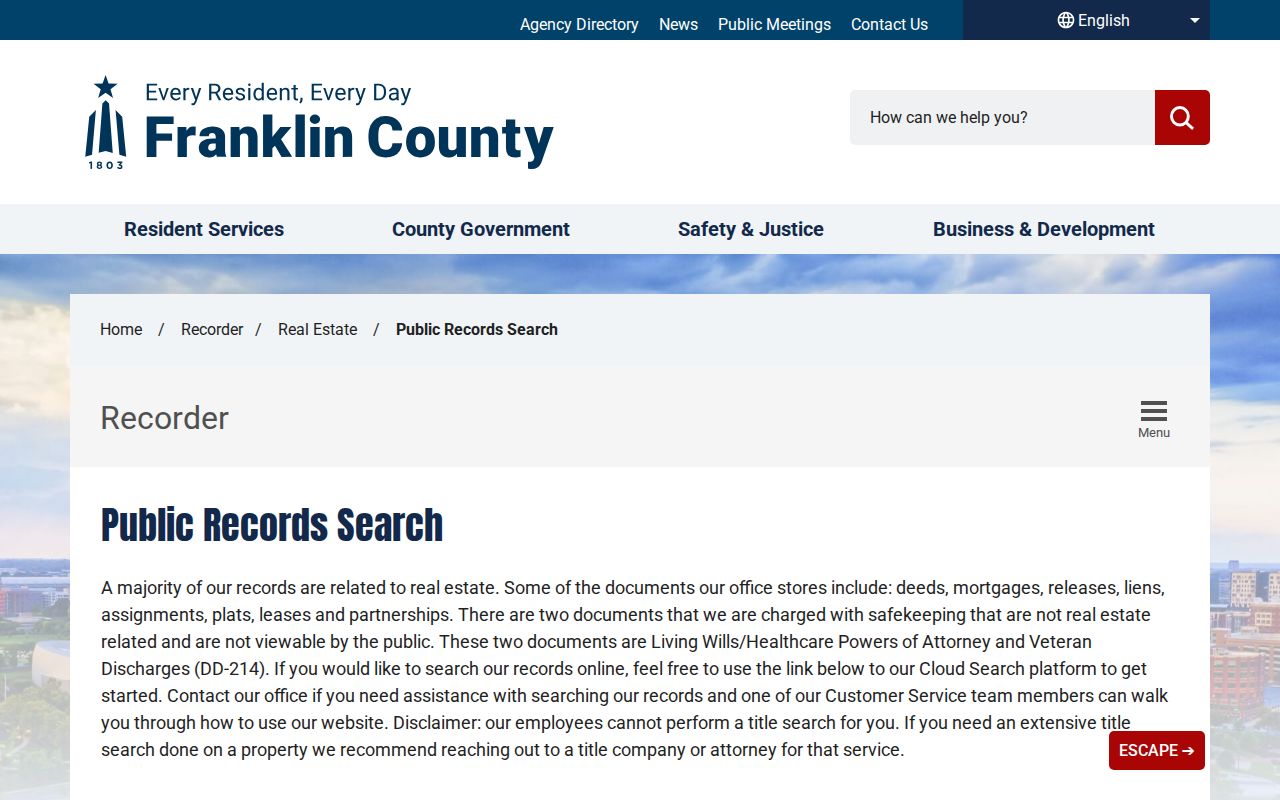
The Recorder's guidance helps set the right expectation for Gahanna previous-resident research: a deed index follows recorded documents, while directories and census schedules supply separate household clues.
Gahanna Previous Residents Start With the Current Parcel
For a Gahanna address, start with the Franklin County Auditor Property Search, not with an address search at the Recorder. The Auditor offers Owner Name, Address, Parcel ID, Subdivision & Condo, Advanced, Map, and Intersection paths. Its address route uses a street name and address number and can account for parcel and building addresses, including ranges. The resulting parcel record is where to capture the parcel ID, site address, legal description, and transfer clue for the next step.
The distinction between site address and owner tax-mailing address is vital for Gahanna previous residents. A site address locates the parcel. A mailing field shows where tax correspondence is directed, which can be a trustee, estate, organization, or owner elsewhere. Neither field names everyone who may have lived at the address.
Franklin County Recorder guidance says an ordinary street address is not an index value. Parcel, legal-description, and named-party information translate the current Gahanna parcel into the keys used by recorded-document research.
Note: A tax-mailing field can be useful for a parcel question, but it does not establish who lived at the Gahanna address.
Trace Previous Residents Through the Franklin County Deed Chain
A deed chain is the recorded ownership trail behind a Gahanna address. It starts with the Auditor record, then moves through Recorder documents using names, parcel information, a legal description, and an approximate recording date. The Cloud Search quick form accepts a grantor or grantee, subdivision, document type, or document number term; it also offers a recorded-date range and Index Only or Index & Full Text OCR modes.
- Resolve the Gahanna address to its current Auditor parcel and copy the parcel ID, legal description, current owner name, and transfer clue.
- Search Cloud Search with the supported party, parcel, legal-description, subdivision, document-type, or document-number route, then read the document date and party roles.
- For the current owner's acquisition, identify the prior grantor. Search that earlier party as a grantee to find the prior acquisition.
- Repeat the recorded relationship one transfer at a time, keeping document type, instrument identifier, date, and legal description with each link.
- At the 1914 boundary, change to the legacy deed-index method rather than assuming the modern index supplies the earlier record.
- Grantor
- The party who conveys an interest in a recorded document.
- Grantee
- The party who receives an interest in that recorded document.
- Chain of title
- The sequence of recorded conveyances used to research an ownership history. It is not a legal title opinion.
- Legal description
- The lot, block, subdivision, or other recorded land description. It can remain more useful than a casual street label in older records.
The Franklin County Recorder says staff can help users operate the search tools, but it cannot perform an extensive title search. For difficult historical research, the documented access channel also includes the Recorder's counter at 373 S. High Street, 18th floor, Columbus, its phone at 614-525-3930, and recorder@franklincountyohio.gov.
Gahanna Previous Residents Cross the 1914 Boundary
The modern Franklin County recorded-deed index begins January 2, 1914. Earlier Gahanna deed research moves to the Recorder's legacy Deed Indexes for 1804 through 1913. The published historical method uses the grantor or grantee role, a surname prefix, an indexed page, then a volume-and-page lookup. It is a different search key from Cloud Search's current index and OCR options.
Some records in the 1804 to 1913 era were destroyed in an 1879 fire, although the Recorder says most were reconstructed. A missing image from that band should lead to a second route through the historical index, volume and page, the office counter, and related Probate or plat material. It should not be treated as proof that no transaction occurred.
Use the Recorder's historical deed-index route for the legacy search and office contact details.
The historical Recorder route is the needed bridge when a Gahanna previous-resident trail reaches the boundary between the modern index and earlier handwritten deed records.
Gahanna Previous Residents and Old Address Labels
An old Gahanna address can conflict with a current map for reasons other than a missing record. The City's retention schedule makes ENG-206 Certified Addresses permanent, including formal requests, address assignments, the address plat book, and address grid. Final plats, as-builts, and annexation files are also permanent. These records can clarify a changed number, subdivision name, municipal line, or description before a historical gap is declared.
Use Gahanna's NextRequest portal or the Council Office and Records Coordinator for a focused request. The Council Office route is 614-342-4090 at 200 S. Hamilton Road, Gahanna, OH 43230. The City says a requester need not use a form, give a name, address, phone number, or reason. Name the address, parcel or subdivision if known, the approximate date, and the specific record series sought. The City does not have to create a new compilation from scattered records.
Under the Ohio Public Records Act, ORC 149.43, the City makes nonexempt records available for inspection or copying during regular business hours. Its published schedule says ordinary electronic delivery often has no charge, while copying, mailing, supplies, unusual formats, or outside-vendor needs may involve actual cost.
Note: No official source located a citywide Gahanna renumbering year, so each historic address should be checked through the permanent address and plat records.
Gahanna Previous Residents in Telephone Books
Telephone books help identify past Gahanna residents only as dated subscriber evidence. Columbus Metropolitan Library directly confirms Franklin County items for 1928, 1932, 1936, and 1944 that name Gahanna. The 1944 record notes that no Polk city directory was printed that year, so the telephone directory is the documented source for that point in the trail.
These volumes do not establish that all Gahanna households had service, and an absent name is not proof of absence from the city. Use the printed name and address as a lead, then compare it with the parcel and recorded-document sequence. The Gahanna city directories collection is the place to assess each volume's scope, front matter, and catalog date.
Note: A Gahanna telephone listing identifies a dated subscriber lead, not a complete household list or a recorded ownership result.
Past Gahanna Households in Directories, Census, and Obituaries
Recorded title and past Gahanna household evidence answer different questions. A telephone book or city-directory line may identify a subscriber or occupant. A federal census places a household at its enumeration date. A deed ties named parties to a recorded document. Keeping those labels distinct is the best way to avoid turning a historical lead into a claim it cannot support.
- Place the phone-book or directory line on a timeline with its exact published year and geographic wording.
- Pair it with the appropriate released federal census, now available through 1950, and preserve the census date separately from the directory date.
- Use CML's Columbus News and Obituary Index to locate a dated newspaper lead, then retrieve and verify the underlying item.
- Check Ohio History Connection's death-index bands or a Franklin County Probate record when a death, marriage, estate, guardianship, or name-change clue would test the trail.
Ohio History Connection's index includes state death certificates for 1913 to 1944 and 1954 to 1970, as well as Columbus Board of Health deaths from 1904 to 1908. A negative index result can still call for a county or local historical check because the state may not have received every county copy.
Probate Endpoints for Gahanna Previous Residents
Franklin County Probate supplies a valuable endpoint when a Gahanna previous-resident trail reaches an estate, a marriage, or an older vital event. The Court reports marriages from 1803 to the present, estate, guardianship, and name-change records from 1898 to the present, and county births and deaths from 1867 to 1908. Most filings received on or after August 2, 1998 have electronic images, while older material can be hard copy, microfilm, or microfiche.
Some Probate matters are confidential, including adoptions, mental-illness, and developmental-disabilities cases. For a nonconfidential record, the Court documents online gateways as well as counter, U.S. mail, and probate@franklincountyohio.gov request channels. Its certified-records page lists ordinary paper at $0.10 per page, CD at $1, and certified copies at $1 per page; check the live Court instructions before requesting a copy.
Consult the Franklin County Probate certified-records information for the current procedures and historical coverage.
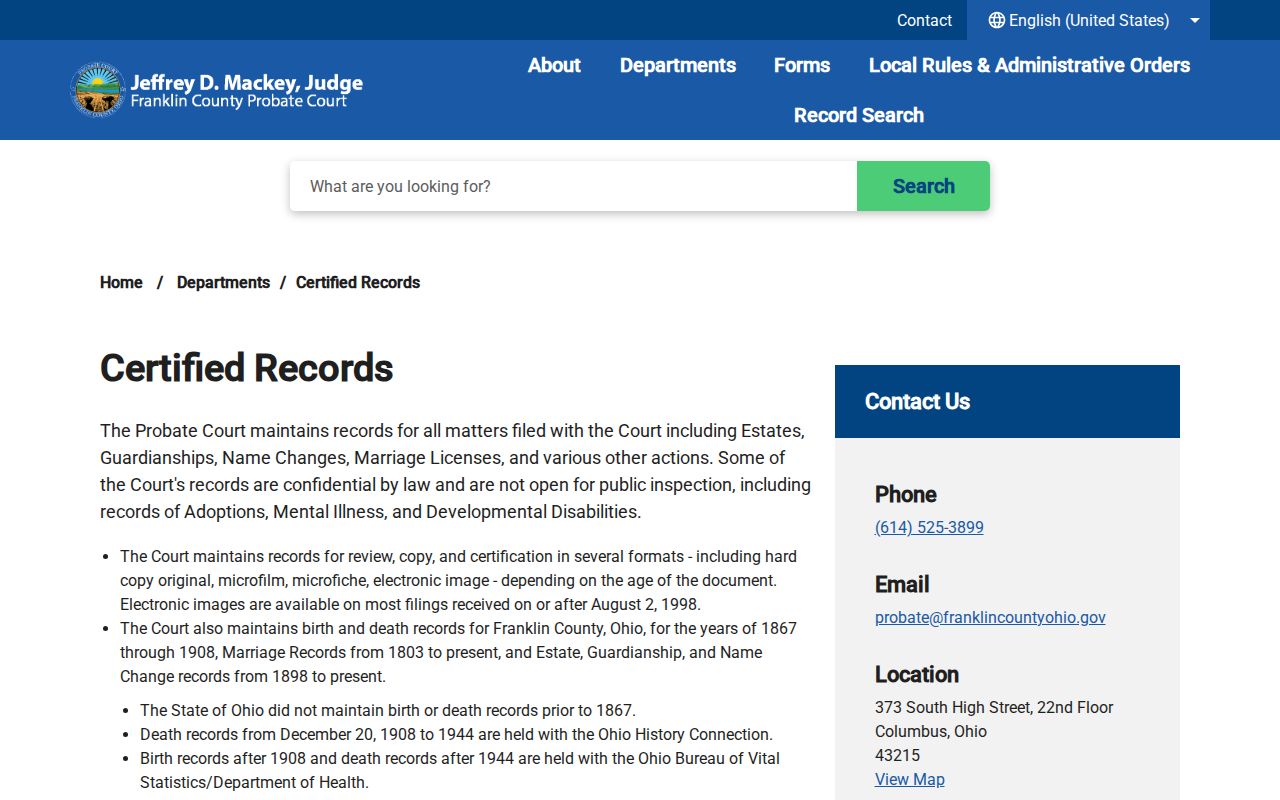
Probate records can connect a Gahanna previous-resident trail to an estate or family event, but a court file should be used only for the specific fact it actually documents.
Gahanna Previous Residents Are Historical, Not Current
Gahanna previous residents research is a date-bound address-history and family-history exercise. A recorded deed party, phone subscriber, census household member, or obituary subject may each support a different historical fact. None of those records creates a current address list, and older material may have access limits, redactions, missing volumes, or incomplete digitization.
Lawful use. Use Gahanna historical records for family history, address history, estate research, or personal curiosity. Do not use a dated record to stalk, harass, or harm anyone.